
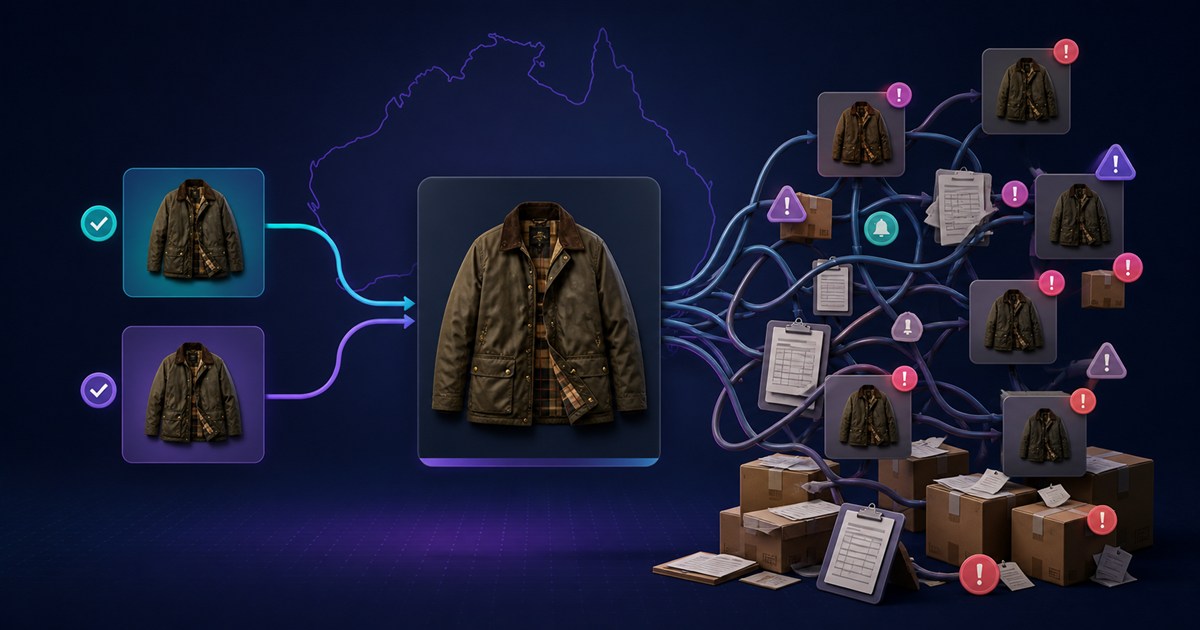
Cross-listing software often promotes one simple idea: more marketplaces mean more chances to sell.
The logic sounds reasonable. If one listing can appear on eBay, Depop, Vinted, Facebook Marketplace, Etsy, Grailed and a luxury marketplace, surely the item is more likely to find a buyer.
For many Australian resellers, the reality is less impressive.
Every new marketplace adds another set of buyers, but it also adds another account, listing format, policy, price, postage workflow, message inbox and sold-item risk. Some platforms do not suit commercial resale at all. Others only make sense for a narrow part of the inventory.
Quick answer
Cross-listing to one complementary second marketplace can be worthwhile. Cross-listing ordinary stock to every marketplace available usually is not.
The goal is not to place an item in the largest possible number of apps. It is to choose the smallest number of marketplaces that reach meaningfully different buyers and can be managed reliably.
For many Australian clothing resellers, that can mean:
- eBay as the broad, search-led primary store
- Depop for suitable fashion stock
- selective use of another marketplace only when a particular item has an obvious reason to be there
Written by Nathan, an Australian reseller and the founder of Listalong. Marketplace eligibility and selling rules were checked against the official sources listed below on 27 August 2026.
More exposure is not the same as more useful exposure
An extra listing can only help when the marketplace has suitable buyers for that item.
A vintage band tee may fit eBay and Depop because the same physical item can appeal to two different shopping behaviours. An eBay buyer may search for the artist, tour, year and size. A Depop buyer may discover it through style, brand and visual browsing.
Putting the same tee on five additional platforms does not automatically create five new groups of likely buyers. Some audiences overlap. Some platforms may have little Australian demand for the item. Some have eligibility rules that make the listing a poor fit before demand is even considered.
The useful question is therefore not:
“How many marketplaces can this software post to?”
It is:
“Which additional marketplace gives this item a genuinely different and relevant route to a buyer?”
The Australian marketplace shortlist is smaller than it appears
International cross-listing tools can advertise long marketplace lists. Australian sellers should evaluate only the channels they can legitimately use, where they can ship competitively and where their stock fits the rules.
| Marketplace | When selective cross-listing may be worthwhile | Why the whole store may not belong there |
|---|---|---|
| eBay Australia | Broad, searchable stock across many categories | It is usually the primary store rather than the extra channel |
| Depop | Fashion, vintage, streetwear and visually distinctive clothing | General household stock and many non-fashion categories are a weak fit |
| Vinted Australia | A genuine personal wardrobe or household clear-out | Vinted’s individual-user rules prohibit listings intended for commercial selling |
| Facebook Marketplace | Bulky items, local pickup, inexpensive bundles and stock that is costly to post | Messages, availability and local arrangements can create substantial manual work |
| Etsy | Qualifying vintage, handmade, designed or otherwise eligible creative stock | Ordinary second-hand clothing is not eligible merely because it is used |
| Grailed | Selected designer, streetwear and enthusiast fashion with a likely specialist buyer | Everyday brands and low-value pieces may not justify international fulfilment and extra administration |
| Luxury resale marketplaces | Authentic higher-value designer items that benefit from a specialist audience | Ordinary inventory, low-value pieces and items without sufficient proof or condition detail are a poor fit |
This is why a platform-by-platform strategy works better than one bulk “publish everywhere” rule.
eBay and Depop can be a sensible two-marketplace combination
eBay and Depop are not identical shop windows.
eBay is broad and structured around searchable product information. Depop is fashion-led and places more weight on the item’s visual and stylistic appeal. A reseller can keep a detailed eBay workflow while adapting suitable clothing for a different buyer on Depop.
Listalong’s current seller activity provides a useful observation: 45% of cross-listed items that sold were purchased on Depop rather than eBay.
That does not mean cross-listing increases sales by 45%. It does not prove that those items would never have sold on eBay later, and it is not a forecast for every store. It simply shows that Depop is doing meaningful work for the cross-listed stock used by current Listalong sellers.
The observation supports a focused second channel. It does not support placing every item on every marketplace.
Why Vinted is not an obvious extra channel for resellers
Vinted Australia can be attractive because it has no standard seller fee and supports a broad personal catalogue. The more important question for a reseller is whether the stock is allowed.
Vinted Australia’s Catalogue Rules say individual users cannot list items intended to be sold for commercial purposes. The rules identify signals such as buying stock in bulk for resale, acting as a retailer, dropshipping and using internet or stock photographs.
That makes Vinted a possible option for a personal wardrobe clear-out, but not an obvious additional shop for somebody sourcing and replenishing commercial inventory.
Our guide to Vinted Australia’s commercial-selling rules explains that distinction fully.
Facebook Marketplace is useful selectively, not universally
Facebook Marketplace can work well when postage is the problem.
Bulky stock, low-value bundles and local pickup items may reach buyers who would never pay to have them shipped. That is a genuine reason to add the marketplace.
It is less convincing as a second copy of an entire clothing store. Local enquiries can involve repeated availability questions, offers, collection arrangements and conversations that do not become sales. A listing that earns little may consume more time than it returns.
Use Facebook Marketplace for the inventory that benefits from local discovery. Do not treat it as a compulsory destination for every eBay or Depop item.
Etsy only works when the stock qualifies
Etsy is not a general used-clothing marketplace.
Its official selling guidance says items must be made, designed, handpicked or sourced by the seller under Etsy’s permitted categories. Vintage items must be at least 20 years old, and ordinary mass-produced resale is not allowed simply because the item is second-hand.
That can make Etsy worthwhile for genuine vintage and other eligible stock. It does not make Etsy a useful bulk destination for a normal modern clothing inventory.
The correct approach is to cross-list the qualifying pieces, not force the whole store into the platform.
Grailed and luxury marketplaces are specialist channels
Specialist marketplaces can be valuable when an item benefits from a more knowledgeable or concentrated buyer audience.
Grailed provides selling tools for designer, streetwear and enthusiast fashion. Luxury resale marketplaces focus on higher-value designer stock and can introduce additional condition, authenticity or fulfilment expectations.
These channels may be worthwhile for a small number of strong items. They become poor uses of time when a reseller posts ordinary inventory simply because the cross-listing software includes the destination.
Specialist platforms should be treated like specialist shops: use them when the product belongs there.
Every marketplace adds invisible operating work
The initial copy of a listing is only the first step.
Each extra marketplace creates ongoing work involving:
- marketplace-specific categories and required fields
- different titles, descriptions and photograph expectations
- pricing and offer management
- buyer messages and measurements
- postage settings and tracking
- returns, disputes and account health
- connection failures and expired permissions
- updating or removing every copy after a sale
- reconciling sales and fees across multiple dashboards
The work may be spread across several five-minute tasks, which makes it easy to underestimate. Over a month, those interruptions can become the largest cost of the additional channel.
This is also why sold-item protection becomes more important as the number of marketplaces grows. One physical item listed twice creates one matching relationship. The same item listed seven times creates a much larger failure surface.
More marketplaces can make automation less reliable
Cross-listing software does not necessarily provide the same level of automation for every marketplace it can post to.
A tool may be able to create a listing but not detect a sale. It may detect sales on one marketplace through an official connection while relying on a browser extension or active session for another. Delisting may work in one direction but not the other.
Before adding a channel, ask:
- Can the software detect a genuine sale there?
- Will it remove every linked copy, or only some of them?
- Does the automation run when my computer is off?
- Will I be warned when a connection stops working?
- Can I see what the software did and when?
- Is the marketplace supported for Australian accounts, postage and currency?
If the answer is unclear, the reseller still owns the risk.
Our separate guide to whether cross-listing software is worth paying for covers subscriptions, listing limits and sold-sync features. This article is about whether the extra marketplaces deserve to exist in the workflow in the first place.
The case for one complementary marketplace
Adding one second marketplace is easier to justify because the seller can learn it properly.
The seller can understand:
- which stock belongs there
- how buyers search and make offers
- what photographs and descriptions work
- how to price for that marketplace
- how postage and returns operate
- how sold-item removal behaves
The workflow remains understandable. When something goes wrong, there are only two listings to trace.
Adding a third or fourth channel should require new evidence. It should solve a problem the existing two marketplaces do not solve—not simply repeat the same audience with more admin.
A simple test before adding another platform
Do not move the entire inventory on day one.
1. Choose a marketplace for a specific reason
Examples include local pickup, a genuine vintage audience, specialist designer demand or a different fashion buyer.
2. Select a small, high-fit group of items
Choose the pieces most likely to suit that marketplace. A random sample of weak-fit inventory will not teach you much.
3. Track the full cost
Record sales, fees, time spent preparing listings, messages, postage differences, returns and software costs.
4. Watch where the items actually sell
Do not judge the channel from views or likes alone. Measure completed sales and the contribution left after the channel-specific costs.
5. Remove the marketplace if it only creates maintenance
A platform does not deserve permanent space in the workflow because it produced one exciting notification. It should make a repeatable contribution that justifies the work.
So how many marketplaces should you use?
There is no universal maximum, but the practical default for many Australian clothing resellers is one primary marketplace plus one complementary marketplace.
Start with one if you are still learning listing, pricing, packing and postage.
Add a second when you can explain which stock belongs there and why its audience is different.
Add a third only when a defined portion of the inventory has a strong specialist or local fit.
Do not add a fourth, fifth or sixth because software makes the button available.
Where Listalong fits
Listalong is our product, so the limitation is worth stating clearly.
It supports a focused eBay Australia and Depop workflow. It does not publish to Vinted, Facebook Marketplace, Etsy, Grailed or Vestiaire Collective.
That narrow scope is deliberate. Australian sellers can continue using the eBay store and listing process they already understand, choose which fashion items also belong on Depop and keep the two supported listings connected after publication.
Listalong is not the right product for somebody who genuinely needs a central inventory system across many marketplaces. A larger multi-platform service may suit that business better.
For a seller who only wants suitable eBay fashion stock to reach Depop buyers, adopting a much larger system can create more workflow than the second marketplace is worth.
See how the eBay-to-Depop workflow works or start your 14-day trial.
Final verdict
For most Australian resellers, cross-listing everywhere is not worthwhile.
The additional marketplaces can create theoretical exposure, but the value falls quickly when the stock does not fit, the buyers overlap or the seller cannot manage each channel properly.
A focused second marketplace can still be valuable. Current Listalong seller activity shows that Depop accounts for a meaningful share of completed sales from eBay-to-Depop cross-listed stock. That supports using Depop where the fashion inventory fits.
Beyond that, make every marketplace prove its value.
Use Facebook Marketplace for local stock. Use Etsy for eligible vintage or creative goods. Use specialist fashion and luxury marketplaces for the pieces that genuinely belong there. Treat Vinted as a personal-selling option under its current Australian rules, not a default commercial expansion channel.
The best cross-listing strategy is not the one with the most marketplace logos.
It is the one you can run well.
Official sources checked
Information checked 27 August 2026:
- Vinted Australia Catalogue Rules
- Etsy: What can I sell?
- Depop: Selling as a charity or business
- Facebook Marketplace Help
- Grailed selling guide
Marketplace rules, availability and fulfilment options can change. Check the current platform documentation before opening or expanding a store.