
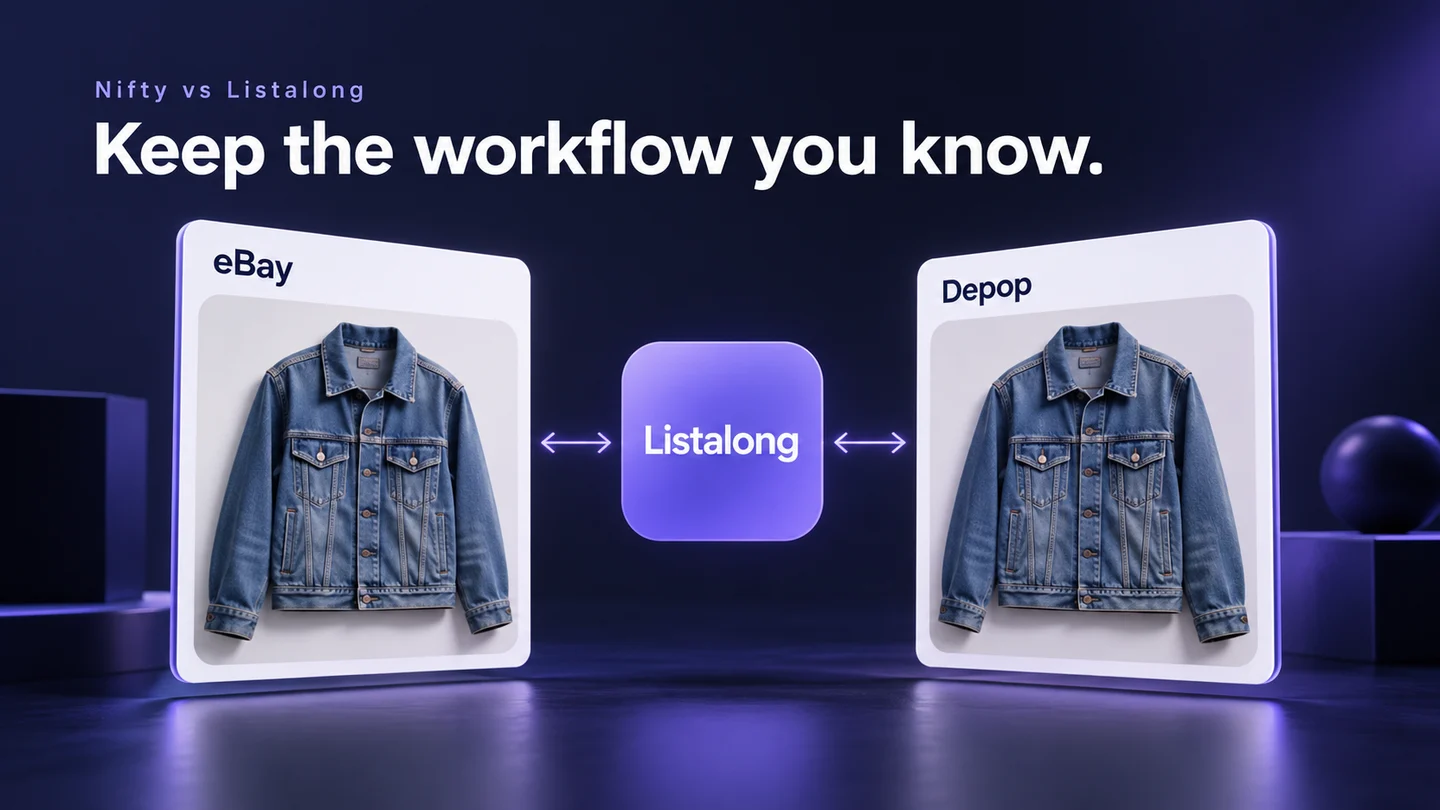
You already know how to photograph stock, write a description and publish a listing on eBay or Depop. What you want from cross-listing software is help with the jobs that follow: getting that item onto another marketplace, refreshing older listings and removing the matching advert when it sells.
That is a useful starting point for comparing Nifty vs Listalong. Both offer tools that reduce repetitive selling work, but they organise that work differently.
Nifty brings together a broader set of listing, automation and business-management tools. Listalong focuses on the work between eBay and Depop, so you can keep creating listings on the marketplaces you already use.
This comparison was checked on 12 September 2026 against published product information. Listalong is our own product. This is a documentation-based comparison, not a hands-on speed or reliability test of Nifty. Features and prices can change.
Nifty vs Listalong at a glance
| Area | Nifty | Listalong |
|---|---|---|
| Main approach | Broad listing, automation and analytics toolkit | Connect existing eBay and Depop stores |
| Listing starting point | AI-assisted creation or existing inventory imports | An existing eBay or Depop listing |
| Marketplace scope | Multiple marketplace integrations | eBay and Depop |
| Cross-listing | Publish across connected marketplaces | Automatic or selected cross-listing in both directions |
| Sold items | Sale detection and automatic delisting in Crosslisting plans | Automatic sold-item sync for linked listings |
| Other automation | Marketplace-specific offers, relisting and engagement tools | Automatic ending and relisting rules |
| Australian shipping | Check the available integrations for your workflow | Combined eBay and Depop order workflow for Australia Post |
| Best reason to consider it | You will use its broader toolkit | You want automation around the stores you already know |
Sources: Nifty’s plan inclusions and Listalong’s features. A shared feature name does not mean identical behaviour, coverage or limits.
Keep listing where you already work
Imagine you have just listed a denim jacket on eBay. You have uploaded the photos, added measurements and described the wear on the cuffs. The listing is ready for buyers.
To offer it on Depop manually, you would need to move the photos, copy the relevant details and complete Depop’s fields. Listalong uses the existing listing as the starting point for that second advert. It can also work the other way, from Depop to eBay.
You can let suitable listings cross-list automatically or select an individual item or group yourself. Available photos and supported details are reused; destination-specific requirements may still need your attention. See what Listalong transfers.
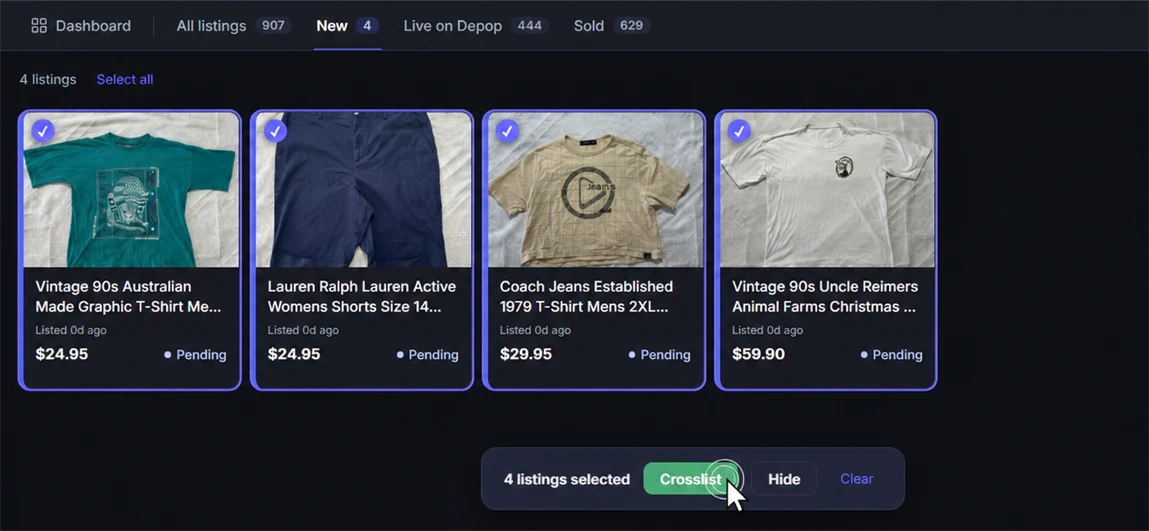
There is still setup involved. You connect accounts, choose settings and review exceptions. The benefit is being able to keep your familiar marketplace listing process as your everyday starting point.
That is the more accurate meaning of cross-listing without learning a new listing platform. You learn the supporting tools, while the work of creating your original listing stays familiar.
Where Nifty offers more
Nifty’s broader toolkit includes AI listing generation, photo tools, drafts, scheduling and analytics. Its separate Automation plans cover marketplace-specific tasks such as offers and relisting; Poshmark also gets sharing and following. Nifty says these automations run without leaving your device open. Explore Nifty’s plans.
Those capabilities may be valuable if you want software to help create listing content or support several sales channels.
Nifty also imports existing inventory. Choosing it does not mean recreating your catalogue. The decision is which additional tools you expect to use, and whether you want them to become part of your daily routine.
Regional availability is a deciding factor: Nifty’s help centre currently limits availability to sellers in the United States, its territories and Canada. Australia is not included in that list. See supported regions (checked 13 September 2026).
Listalong does more than copy listings
The first cross-list is only one part of managing the same physical item across two stores. Listalong’s current feature set also includes:
- Automatic sold-item sync: end the matching linked listing after a sale.
- Automatic ending and relisting: choose rules to refresh older listings.
- Bulk catalogue tools: cross-list or refresh suitable groups of items.
- Marketplace matching and suitability checks: surface requirements and potentially unsuitable stock.
- Connection monitoring and activity history: see when a connection needs attention and check recorded actions.
- Store reporting: review sales, revenue and inventory performance.
- Australia Post shipping and tracking: handle eligible orders from both marketplaces together.
These are practical reasons to pay for software even when you are comfortable writing your own listings. The repeated work around the listing is still work.
Shipping is part of the workflow too
Listalong can export eligible eBay and Depop orders together for Australia Post. After creating labels, upload the label PDF so tracking can be matched and returned to supported orders. Read about the shipping workflow.
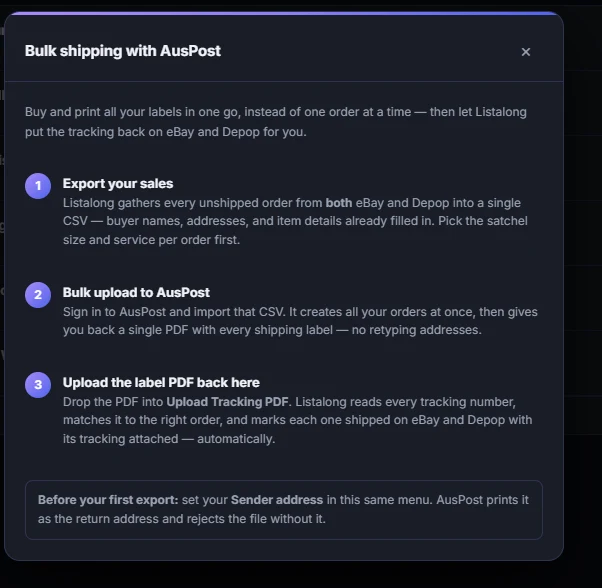
If your packing routine includes orders from both marketplaces, test that full sequence. A tool’s value becomes clearer when you try the jobs you actually repeat each week.
Compare Nifty and Listalong pricing
The table below puts both products’ monthly subscriptions in one place. Nifty separates cross-listing from marketplace automation; Listalong includes every current feature in both plans, with the plan determined by store size.
Currency note: Listalong prices are in Australian dollars (A$). Nifty prices below reproduce the dollar amounts displayed on its pricing page; that page does not explicitly label the currency. Confirm Nifty’s billing currency and final checkout total before making an AUD comparison. These are not currency-converted prices.
| Product and plan | Monthly subscription | What the plan covers |
|---|---|---|
| Listalong Standard | A$19/month | Every current Listalong feature; fewer than 1,500 active linked items |
| Listalong Large Store | A$39/month | Every current Listalong feature; 1,500–3,500 active linked items |
| Nifty Crosslisting Plus | $39.99/month* | Cross-listing, sale detection, AI tools and analytics; up to 1,500 active items |
| Nifty Crosslisting Pro | $59.99/month* | Crosslisting features with higher inventory and AI-credit allowances |
| Nifty Bundle Plus | $69.99/month* | Crosslisting Plus and Full Automation |
| Nifty Bundle Pro | $89.99/month* | Crosslisting Pro and Full Automation |
| Nifty single-marketplace Automation | $25/month* | eBay or Poshmark automation; cross-listing requires a different plan |
| Nifty Full Automation | $39.99/month* | Automation across supported marketplaces; cross-listing requires a different plan |
Nifty amounts are shown as displayed, not in confirmed AUD. Monthly billing prices checked on 12 September 2026. Sources: Nifty pricing, Nifty’s plan guide and Listalong pricing.
Which rows should you compare? If you want cross-listing and sold-item sync, start with Nifty’s Crosslisting plans and the Listalong plan that fits your store. If you also want Nifty’s marketplace engagement automations, look at its Bundle plans. The products have different features and marketplace coverage, so the table is a cost comparison, not a claim that the plans are equivalent.
Listalong’s annual options are A$190/year for Standard and A$390/year for Large Store, saving two months compared with monthly billing. Nifty also offers yearly billing at discounted rates; check its current annual checkout total before subscribing.
For Listalong, one item linked on both marketplaces counts once; sold, ended and historical listings do not use the active allowance. For more than 3,500 active linked items, contact Listalong about capacity. See full plan details.
Listalong’s 14-day trial starts when both eBay and Depop are connected. Setup time does not count, no card is required, and continuing afterwards requires choosing a subscription. Nifty advertises a 7-day trial.
Put a value on the work you remove
As an illustration, if a tool saves you two hours a month and you value that time at A$25 an hour, that is A$50 of time against the subscription cost. This is a way to assess your own workflow, not a measured time-saving claim for either product.
During a trial, note how much time you spend cross-listing, correcting fields, checking sold stock and handling orders. Include the time you spend using the tool itself. You can also use our cross-listing ROI calculator to explore your numbers.
Sold-item sync is useful, but timing matters
For one-off second-hand stock, getting the other listing down after a sale matters as much as getting it published.
Listalong monitors linked listings and normally ends the matching advert within minutes. A slow marketplace or interrupted connection can delay that process. Two buyers can also purchase close together, so sold-item sync reduces double-selling risk without eliminating it. Read the sold-item sync details.
When comparing tools, check which items are linked, how connection problems are shown and what action you need to take if syncing stops. These details tell you more than a simple automation rating.
Which tool fits your store?
Consider Nifty if you want AI-assisted listing creation, broader marketplace coverage and its additional automation tools. Those features make more sense when they support work you regularly do.
Consider Listalong if eBay and Depop are your focus, you prefer creating listings directly on those marketplaces, and you want help with cross-listing, ageing stock, linked sold items and Australian shipping.
Neither product is a marketplace where buyers shop. You keep selling through your connected stores. You are choosing the software that helps you run them.
For an eBay and Depop seller, Listalong’s proposition is straightforward: keep the listing workflow you know, and pay for help with the work you keep repeating.
Explore Listalong’s workflow or compare plans and start your 14-day trial.
Frequently asked questions
Is Listalong an alternative to Nifty?
Yes, for sellers who need automation around existing eBay and Depop listings. It is not a feature-for-feature replacement for Nifty’s broader toolkit. Compare the tasks you need rather than assuming every capability is shared.
Do I need to create listings inside Listalong?
No. Start with an existing eBay or Depop listing. You still configure Listalong and review items that need attention, but you can continue creating your original listings through your usual marketplace.
Does Listalong cross-list in both directions?
Yes. Its current workflows support eBay to Depop and Depop to eBay, automatically or by selecting items yourself.
Is Listalong free?
It has a 14-day trial, followed by paid plans if you choose to continue. Older comparisons describing ongoing free access do not reflect the current pricing.
Does Nifty support existing listings?
Yes. Nifty supports inventory imports as well as creating new listings. Existing stock does not need to be rebuilt from scratch.