
To research vintage Australian clothing labels, photograph the exact wording, identify what each label describes and compare it with documented garments or archive records. Then check whether the rest of your garment supports the proposed identification and period.
A familiar brand, an old-looking typeface and an Australian address are useful research leads. They do not establish an exact year, authenticity or resale value by themselves. Keep those questions separate so your eventual listing says what you can support.
Open the printable garment-label research record. Use one sheet per item to save the label text, source links, matching details and unresolved questions.
Photograph the whole garment before concentrating on the tag
Start with the front, back, inside and every attached label. Include brand wording, size marks, care and fibre information, country wording and any product numbers. Photograph where each label is attached and what the surrounding stitching looks like.
Keep a photograph of the entire garment with the same stock reference as the close-ups. A detached screenshot of a neck label is much less useful if you cannot tell which dress it belongs to.
Transcribe what is visible, preserving spelling and numbers. If a letter is unclear, record both possible readings in your private notes. Do not replace an uncertain name with the name of a better-known designer because the typography looks similar.
Separate identity, origin, age and value
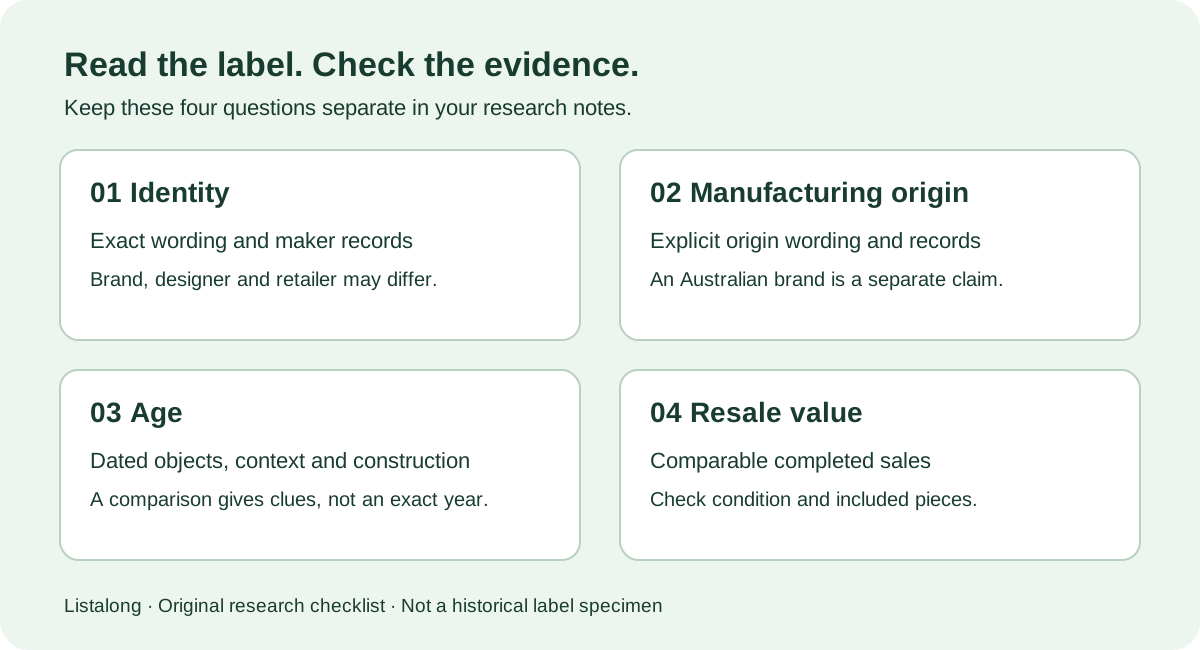
A reading checklist, not a historical label specimen.
| Question | Evidence to look for | What not to assume |
|---|---|---|
| Who is named? | Exact brand, designer, retailer or maker wording | Every name on a label identifies the same role |
| Where was this item made? | Explicit manufacturing-origin wording and supporting records | A brand’s nationality or an Australian address proves local manufacture |
| When was it made? | Dated objects, catalogues, provenance and compatible garment details | An old brand’s founding date is this garment’s production date |
| What might it sell for? | Comparable completed sales with matching condition and identity | A museum holding or a high asking price establishes today’s resale value |
Keep the original label wording in your notes even when the evidence supports a more detailed interpretation. That gives you a way to revisit the conclusion if a better reference appears.
Use museum examples as documented comparisons
The following are reference objects, not a dating chart for every garment carrying the same name. Open the collection record and compare its description, inscriptions and context. The dates belong to those documented objects.
Prue Acton: Museums Victoria records a blue linen dress made in 1965, with provenance linking it to the designer and separate numeric inscriptions. Its 1971–72 batik dress records the Prue Acton name and Australian wording. Together they illustrate why the name alone cannot assign one year to another garment.
Norma Tullo: An RMIT Design Archives dress on Victorian Collections documents the Tullo name with Peppinella wording, separate care and sizing labels, and a connection to the fabric introduced into her range in 1973. The useful research move is linking the wording to a documented material and design context, rather than treating any wool dress as that example.
Pelaco: The NGV’s shirt dated about 1980 includes a transcription of its neck label, including the Pelaco name, sizing and product wording. Compare those details with the actual shirt’s construction and measurements. That record does not establish that every green Pelaco label dates to the same period.
These records provide more than an attractive comparison photograph: they identify the object, its attribution and the evidence the institution has recorded. Cite the record you used in your private research notes. Take your own photographs of the item you intend to sell.
Check brand history without turning it into a shortcut
Company and designer histories help you formulate questions. They can identify collaborations, licensed production, retailers and changes in the business. They should not become automatic dates for garments you have not matched.
For example, RMIT’s Norma Tullo collection description discusses her work with Butterick and Isetan as well as her own business. That makes it worth asking which production context a label represents, rather than assuming a designer’s name always means the same manufacturer or country.
Search the exact label wording with the garment type, then add a retailer, place name or distinctive material where those are actually present. Save the source URL and the part of the record that supports your conclusion. A search-result thumbnail without a traceable record is only a lead.
Compare the garment, not just the lettering
Use construction, silhouette, fastenings, lining, measurements and signs of alteration as additional checks. Ask whether they are consistent with the proposed period and whether a label could have been replaced. Several consistent details are more useful than a single supposed rule about a zip, care label or typeface.
Do not apply a universal size conversion to a historical size mark. Measure the actual garment and explain the labelled size separately. Our clothing measurement guide provides a repeatable method.
If you need broader references, the Vintage Fashion Guild Label Resource provides a research starting point. Information courtesy of the Vintage Fashion Guild Label Resource. Circa’s Australian label discussion offers examples of reading several label clues together. Treat references as evidence to compare, not permission to copy their photographs into your advert.
Write down what the evidence can and cannot establish
Use three lines in the research record: observed, supported interpretation and unresolved. For an original hypothetical example:
| Record | What you might write |
|---|---|
| Observed | Brand wording is readable; country-of-manufacture wording is absent; size mark and measurements photographed |
| Supported interpretation | A documented comparison has a similar label layout and garment shape |
| Unresolved | Exact year, production location and whether this piece belongs to the same range |
That is a stronger record than silently converting a visual resemblance into “Australian-made 1965 original”. If you cannot substantiate an exact year, do not put it into the listing title as a fact.
Keep the resale description useful when the date is uncertain
Describe the actual garment: visible label, material information you can substantiate, measurements, fastening, lining, condition and alterations. Separate an attributed period from a verified production date, and explain the basis for any attribution you choose to make.
Use the used-clothing condition guide to keep wear and repairs visible. For a contemporary item whose model is the main mystery, use the dress-name and style-code guide instead.
After identification, research comparable sold items before choosing a price. Once the description is accurate, Listalong can help reuse supported listing details across its marketplaces. Keep any uncertainty in the destination description rather than allowing a copied title to turn a tentative identification into a stronger claim.